In the fast-paced world of Emergency Medical Services (EMS), staying up-to-date with the latest training…

The Role of AI in EMS Education and Training
Artificial intelligence (AI) is becoming part of many industries, including healthcare and public safety. In emergency medical services (EMS), AI is not replacing providers or educators—but it is beginning to influence how training is delivered, how learning gaps are identified, and how administrative tasks are managed.
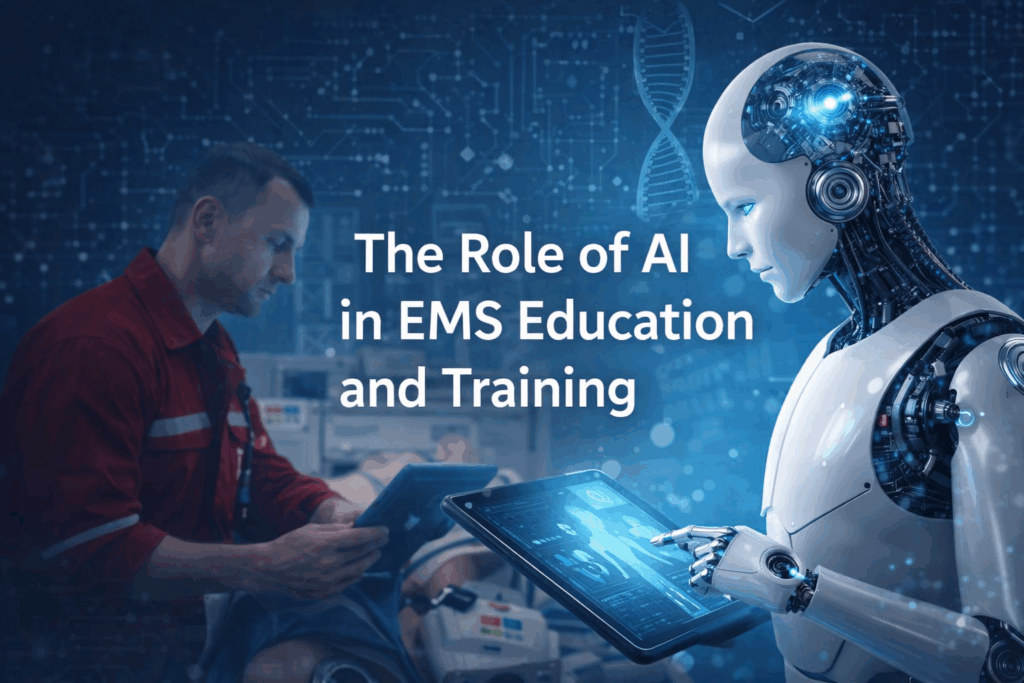
Understanding what AI can do, what it should do, and where its limits are is essential for EMS professionals, educators, and agency leaders. When used appropriately, AI can support education and readiness. When misunderstood or overused, it can create risk.
This article explores the practical role AI plays in EMS education and training today, and how it may continue to evolve.
AI in Training Simulations
One of the most promising uses of AI in EMS education is simulation-based learning.
Traditional simulations rely on static scenarios that follow a fixed script. AI-driven simulations, by contrast, can respond dynamically to learner decisions. For example, a virtual patient’s condition may worsen or improve based on airway management choices, medication timing, or assessment accuracy.
Benefits of AI-assisted simulations include:
- More realistic decision-making environments
- Exposure to rare but critical scenarios
- Immediate feedback based on actions taken
For EMS learners, this type of training helps reinforce clinical reasoning rather than memorization. For educators, it provides insight into how learners think under pressure.
However, AI simulations are best viewed as supplements, not replacements, for hands-on training. Psychomotor skills, scene management, and real-world communication still require live practice and instructor oversight.
Adaptive Learning in EMS Education
Another area where AI is gaining traction is adaptive learning.
Adaptive learning systems analyze learner performance over time. Based on quiz results, response patterns, and course progress, the system can:
- Recommend additional content
- Revisit weak areas
- Adjust pacing to the learner’s needs
For EMS education, this can be particularly useful in continuing education (CE). Providers often have varying levels of experience depending on call volume, specialty exposure, and role. Adaptive learning allows education to focus on reinforcement where it’s needed most.
For example:
- A paramedic strong in cardiology but weaker in pediatrics may receive targeted pediatric refreshers.
- A returning provider may benefit from more foundational review before advancing to complex topics.
When implemented thoughtfully, adaptive learning supports efficiency without lowering standards.
Documentation and Administrative Support
AI also has a growing role in reducing administrative burden—an area where EMS agencies and providers often struggle.
In education and training contexts, AI tools can assist with:
- Automated quiz grading
- Course completion tracking
- Credential and CE hour reporting
- Learning analytics and compliance reporting
In operational EMS, similar tools are being explored for documentation support, such as voice-to-text charting or structured data entry prompts.
From a training perspective, this matters because less time spent on paperwork means more time available for:
- Skills training
- Quality improvement
- Clinical education
That said, documentation tools must be carefully validated. Errors, omissions, or over-reliance on automation can introduce compliance or clinical risk if not reviewed by humans.
What AI Can Do Well in EMS Education
When used responsibly, AI can:
- Support individualized learning paths
- Improve access to education for shift-based providers
- Provide consistent educational content
- Help identify trends in learner performance
- Reduce repetitive administrative tasks
AI is especially effective when paired with CAPCE-accredited, standards-based education that is reviewed and updated by subject matter experts.
What AI Should Not Do in EMS
Equally important is understanding AI’s limitations.
AI should not:
- Replace clinical judgment
- Make independent patient care decisions
- Override protocols or medical direction
- Replace instructor-led education entirely
- Be treated as an authority without human review
EMS is a profession built on accountability, ethics, and real-world decision-making. AI can support those goals, but it cannot replace experience, situational awareness, or professional responsibility.
Any AI-supported training program must include:
- Human oversight
- Clear accountability
- Transparent limitations
- Regular review and validation
Ethics, Accuracy, and Trust
For EMS education providers and agencies, trust is critical. AI tools must be:
- Transparent in how recommendations are generated
- Based on accurate, evidence-informed content
- Compliant with privacy and data security standards
From an educational standpoint, AI should enhance—not obscure—learning objectives. Providers should understand why content is presented and how their performance is evaluated.
This aligns closely with modern expectations around educational quality, accountability, and professional standards.
The Future of AI in EMS Training
Looking ahead, AI will likely play a growing role in:
- Simulation realism
- Learning analytics
- Training program planning
- Competency assessment support
The most effective EMS education models will combine:
- CAPCE-accredited coursework
- Experienced EMS educators
- Technology that supports—not replaces—clinical excellence
AI is a tool. Like any tool in EMS, its value depends on how well it is understood, applied, and supervised.
AI has a meaningful role in the future of EMS education and training—but only when used with intention, expertise, and clear boundaries.
For EMS professionals, the goal remains the same: provide safe, effective patient care. Education must support that mission, not distract from it.
At 911 e-Learning Solutions, technology is used to improve access, consistency, and efficiency—while maintaining high educational standards and professional oversight.
As EMS education continues to evolve, AI will be part of the conversation. The responsibility lies with educators, agencies, and providers to ensure it is used wisely.
Written by: the 911-eLearning Solutions Team